Gladys’ mission to reimagine economic futures through mātauranga Māori and the ‘jandal effect’
Gladys Henderson’s study builds on and strengthens her existing mahi across economics, policy and finance. But at its heart, it’s about people and place. Her study focuses on rebuilding the systems that govern whenua Māori, wealth and wellbeing from within mātauranga Māori. It is a kaupapa grounded in intergenerational responsibility, the same kind of responsibility carried by those who went to war and never came home.
Gladys (Ngāti Pikiao, Ngāti Whakaue) is a Te Arawa wahine, based in Queenstown. She is a recipient of a Sir Āpirana Ngata scholarship after applying as a descendant of the late Turanga Maaka, who is Gladys’ koro and served in World War II.
Her PhD examines how mātauranga Māori can form the basis of financial and economic models, rather than being tacked onto existing Western systems.
Alongside her doctoral research, Gladys works for Kauati Ltd – a Māori owned strategy and research consultancy, based in Whakatipu Waimāori. Gladys’ role focuses on Māori economic strategy and mātauranga Māori socio-economic impact assessment.
Through this mahi, Gladys supports iwi, hapū and tiriti partners to develop economic tools and decision-making processes that are grounded in te taiao (the environment), mātauranga Māori, whakapapa and a responsibility of Māori shaping economic futures.
“Mātauranga Māori has always been here. The problem is the tools, the economic models, we use to make decisions were never built for us,” she says. “Mātauranga Māori is becoming increasingly visible across financial, economic and sustainability reports all over Aotearoa. However, the systems that determine the value, investment and long-term outcomes, especially when we’re talking about whenua Māori, remain largely at a standardised, external world view.”
The challenge is to ensure that when mātauranga Māori is referred to in reports, it is not merely acknowledged but meaningfully embedded. “Sometimes I’ll be reading a report which will refer to Māori values. But then when it comes to reading about the economic models the report is based on – it’s clear that they’re not tied to wealth and inter-generational wellbeing,” she says.
Her research offers tools that support Māori-led planning, reporting and aspiration-setting for whānau and whenua. Moving away from Western models. The tools are grounded in people and place – adaptable to the mātauranga, tikanga and lived realities of particular iwi, hapū and whenua.
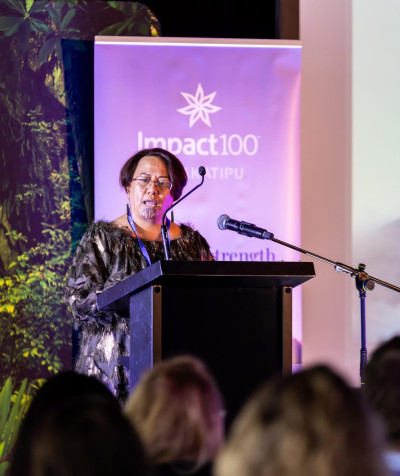
Image credit: 45 South and Impact 100
Gladys’ approach to study is structured in kaupapa Māori and place-based Māori methodologies. These methodologies ensure that Gladys’ research is relational, place-based and its accountable to whakapapa, whenua and future generations. Gladys’ methodology was visually designed for her, by Paris Tainui (Ngāi Tahu) and called The Tohu. The Tohu is a structured interpretation, carrying whakapapa into practice, and disciplining interpretive movement – making positionality operational rather than declarative.
Through her mahi, Gladys says she often finds herself in privileged spaces where there are few Māori voices. Whilst actively engaging in her own mahi, she also sees part of her role is to help to bring others in and ensure Māori are at the table.
“I call it the jandal effect,” she says. “If I can open the door, I’ll throw a jandal in to wedge it open and leave it that way.” At times, this means working to shift mindsets toward a kaupapa more grounded in people and place. But Gladys recognises that not everyone is ready for that conversation – or that she may not always be the right person to carry it forward. “But if the jandal is there in the door, at least the door has been opened,” she says. “That conversation might not be for me. It might be for someone coming in after me.”
Gladys has the following advice for those following her or pursuing further study: “Trust your whakapapa, your lived experience, your whakaaro (instincts). Because Māori knowledge is something not to set aside in your education or workplace, because it's a real intellectual strength. It's literally a Māori superpower. Also, seek out supporters who understand that Māori education is about serving whānau, serving whenua and serving future generations.”
Gladys says that receiving the scholarship has provided her with “the time, stability and space to carry the kaupapa with care. It has ensured that my research is undertaken in a really consistent kaupapa Māori way.”
Now in her final year of her PhD, upon completion, she aims to “keep working alongside iwi, Māori organisations and policy spaces to support Māori-led approaches to land, development and wellbeing.”
About the Sir Āpirana Ngata Memorial Scholarship
The scholarship was created by the Māori Soldiers Trust Act 1957 to promote higher education of Māori. Funding for the scholarship comes from Hereheretau Station, Wairoa, the major asset of the Māori Soldiers Trust.
The scholarship is administered by the Māori Trustee and Te Tumu Paeroa, on behalf of the Māori Soldiers Trust Committee.
All those with whakapapa Māori that are studying at tertiary level are eligible for the scholarship, with descendants of Māori World War I veterans given priority.
You can find out more about the scholarship here.